For many farmers across Nigeria, the biggest challenge is not growing food. It is finding reliable buyers before their harvest spoils. While conversations about agriculture often focus on production, far less attention is given to what happens after harvest, a gap that continues to cost farmers income, opportunities, and livelihoods.
As a postgraduate student at the University of Ibadan, Toyosi Olatayo set out to tackle that challenge. After researching companies that sourced cassava, she contacted more than 20 organisations through emails, phone calls, and LinkedIn before eventually securing Dufil Prima Foods as Palmira Farm Trade’s first commercial client. Today, her company connects smallholder farmers with reliable buyers while advocating for stronger post-harvest systems across Nigeria.
Could you tell us about yourself, your journey into agriculture, and what shaped your path?
My name is Toyosi Olatayo, and I am from Eruwa in Ibarapa East Local Government Area of Oyo State, Nigeria. Eruwa is a rural farming community where I spent my early years.
Farming was simply part of my life; my grandparents farmed, and although my father was a civil servant and a pastor, he also maintained a farm. Most people in our community, including teachers, nurses, and other professionals, were involved in agriculture in one way or another.
I studied at the University of Ibadan, where I completed both my undergraduate and postgraduate studies. I studied Geography during my undergraduate years, and courses in rural geography made me look more closely at the community I came from. I began asking myself a simple question: if agriculture is the main economic activity here, why are so many people still struggling financially?
That question became the focus of my undergraduate research on the causes of poverty in Ibarapa East Local Government Area. One finding that stood out was that most active farmers were over 40, while many younger people had left for urban areas in search of opportunities elsewhere. It highlighted a growing gap between agriculture and the younger generation.
So when people ask how I got into agriculture, I say I didn’t enter the sector in the conventional sense. Agriculture had always been part of my life, but studying it closely made me want to be part of the solution.
What sparked your passion for agritrade and led to the creation of Palmira FarmTrade?
I always tell the watermelon story because it explains why I do what I do far better than any figure or report ever could.
When I was a teenager, my family planted watermelon, counting on the harvest to pay our school fees and support our household.
The harvest was good; we produced enough watermelon to fill several pickup trucks. Then came the problem: we couldn’t find buyers, day after day, the watermelons sat there until they began to rot.
What was rotting on that farm wasn’t just watermelon; it was my school fees, my siblings’ school fees and months of hard work, everything my family had hoped that season would bring.
Years later, I understood that what had happened was market failure. I also realised my family’s experience wasn’t unique; farmers across Nigeria produce food but struggle to access reliable markets.
That experience sparked my interest in the systems that connect farmers to markets and eventually led to Palmira FarmTrade. No farmer should do everything right and still lose simply because there is no buyer.
How would you describe your company’s work in practical terms? What does Palmira Farm Trade do?
At Palmira FarmTrade, we focus on the events that occur between harvest and sale. A lot of discussions around agriculture centre on production, such as increasing yields, improving seed varieties, or applying the right inputs. Those things are important, but they are not the biggest challenge for many of the farmers I work with.
Most of the farmers we work with, many of them women, know how to grow quality produce. Their biggest challenge is finding buyers quickly and selling their products at fair prices before the produce goes bad.
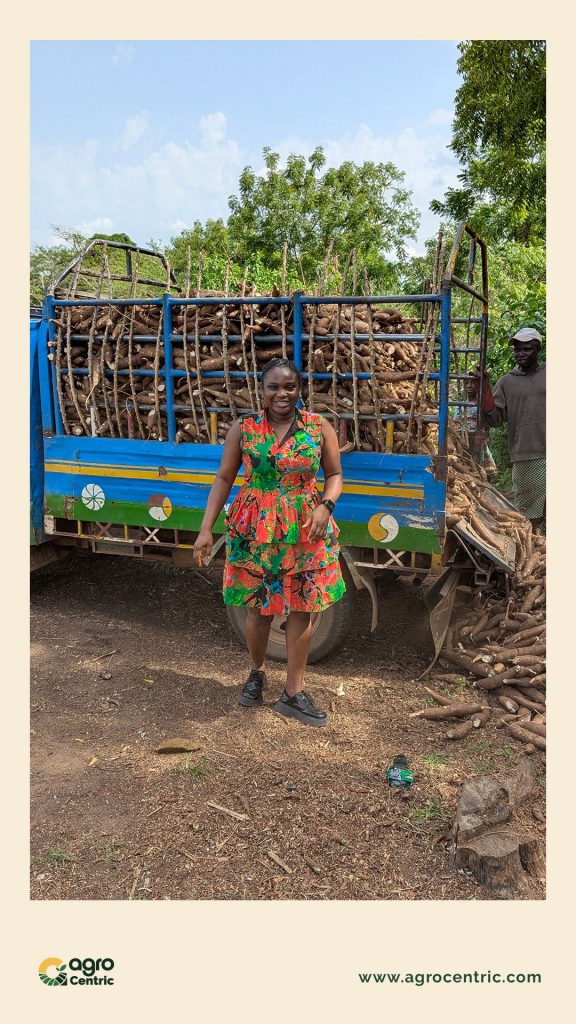
Palmira Farm Trade comes in to aggregate produce from smallholder farmers and connect them with reliable commercial buyers. We reduce post-harvest losses by bridging both sides, while giving farmers a more reliable route to market and helping buyers source the quantity and quality they need.
How did you secure your first client?
Interestingly, I didn’t set out to build Palmira Farm Trade as a business from day one.
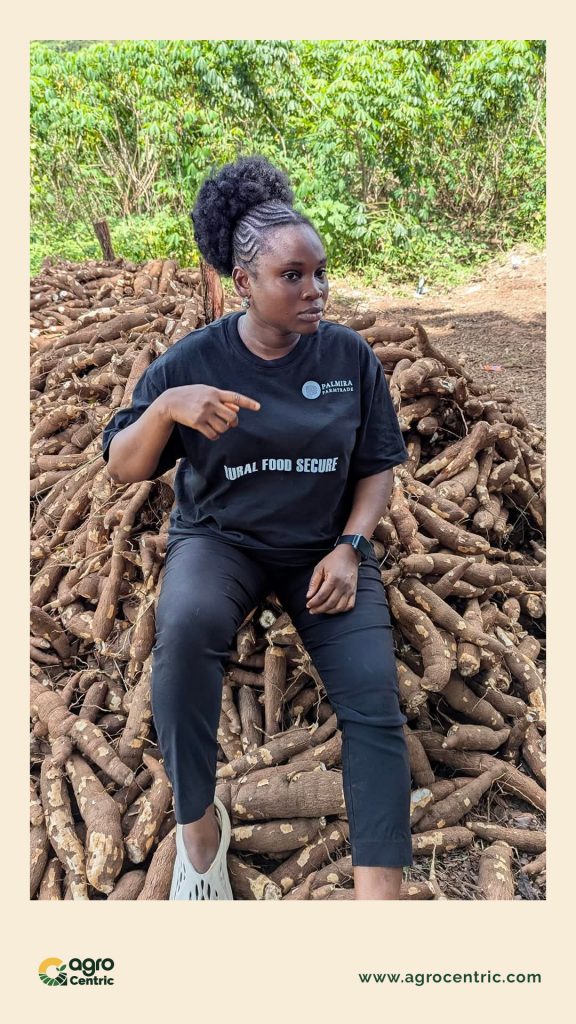
At the time, I was a postgraduate student at the University of Ibadan trying to figure out how to pay my third-semester fees. My mind kept going back to Eruwa, where I had already researched causes of poverty in the farming community during my undergraduate studies. I was aware that cassava was produced in large quantities, but farmers often struggled to find reliable buyers and relied on middlemen who bought at very low prices in Eruwa.
I started wondering whether there was a way to connect those farmers directly with companies that needed cassava as a raw material. So I began researching online. I started by making a list of companies that used cassava and reached out through emails, phone calls, and LinkedIn messages. I contacted more than 20 organisations, most never replied, and some were understandably cautious because I was approaching them without an established business or track record.
Eventually, Dufil Prima Foods responded, and we met at the International Institute of Tropical Agriculture (IITA), where they explained they were looking for cassava suppliers because the communities around some of their operations could not produce the quantities they required.
It didn’t happen overnight; it took months of persistence, follow-up, and several conversations before trust was built, and that was the beginning of Palmira FarmTrade.
What have been some of the biggest challenges you face working in the agricultural trade landscape in Nigeria?
One of the biggest challenges I face is infrastructure. In the communities where we operate in Oyo State, poor road networks are a major obstacle. There are times when transporters are reluctant to move produce because of the poor road conditions. When that happens, food is available in rural communities, but there is no efficient way to get it to the people who need it.
Farmers produce successfully but struggle to sell because their produce cannot move quickly enough, which leads to post harvest losses, while consumers in urban areas still face shortages and higher prices.
Storage is another challenge. Many rural communities lack cold storage facilities, reliable electricity, and local processing capacity, so produce that could have been stored or processed often goes to waste.
Rising transportation costs also affect both farmers and buyers. High fuel prices and logistics costs make transactions more difficult, reducing profitability and limiting market access.
Security is another serious concern. I’ve spoken to farmers who have reduced the time they spend on their farms, and in some cases, stopped going altogether because of security concerns.
These challenges are all connected and will lead to much of the value created on the farm being lost before it reaches the market.
How has Nigeria’s policy environment affected your work?
Most agricultural policies in Nigeria are focused on production – increasing output, planting more, cultivating more land, and producing more food. Those are important goals, especially with a growing population, but what happens after harvest receives far less attention than it should.
Farming communities still lack the infrastructure needed to move, store, process, and market their produce effectively. We need more investment in storage facilities, rural power supply, processing centres, transportation networks, and market systems that connect farmers to buyers.
Are there any emerging trends or shifts in Nigeria’s agribusiness space that you find promising?
One of the most encouraging trends I have noticed is the growing interest of young people in agriculture. For a long time, agriculture was often seen as something people turned to when other opportunities were unavailable. I am glad that perception is gradually changing.
Young people now see agriculture as a business and an investment opportunity rather than simply a means of survival. They are paying attention to different parts of the value chain, from production and processing to agritech and agricultural trade.
Nigerians in the diaspora are also getting interested in agriculture. They want to understand how they can invest in agriculture back home, whether directly or through partnerships.
Another encouraging trend is the emergence of new agricultural investment models, including farm estate developments and other private-sector initiatives that are making agricultural investment more accessible.
The most promising change is the mindset shift because the change in perception brings new ideas, new capital, and new energy into the sector.
Do you utilise digital tools or technology in your operations?
At the moment, WhatsApp is our most important digital tool. It is how many of the farmers we work with communicate with us. They use it to tell us when their produce is ready, share updates on their harvests, send photographs of their farms, and discuss pricing and logistics. That simple line of communication allows us to stay connected in real time and respond more quickly to market opportunities.
We are also exploring how artificial intelligence can support smallholder farmers. Although many of the tools being developed are not designed with rural farmers in mind, particularly those who communicate in their local languages than in English.
Many smallholder farmers operate informally, and simple tools that allow them to record activities through voice notes or local-language interactions can help them organise information and make better business decisions.
I believe the future lies in building technologies that meet farmers where they are, rather than expecting farmers to adapt to technologies that were not designed for them.
What innovations could transform agricultural trade across Nigeria and Africa?
I would say the starting point is infrastructure because we cannot transform agricultural trade without investing in the systems that allow food to move efficiently. That means better rural roads, storage facilities, cold rooms, and reliable electricity in the communities where food is produced.
A lot of our food comes from rural areas, but many of those communities lack the infrastructure needed to preserve and move what they produce. Without storage, farmers are often forced to sell quickly at poor prices or risk losing their harvest.
The government cannot do everything alone, but it can create the right environment for the private sector to invest. If policies are clear and supportive, companies can build rural processing centres, solar-powered cold rooms, and logistics systems that strengthen the agricultural value chain.
Electricity is also critical because it creates opportunities beyond farming. It encourages processing businesses, creates jobs, and gives young people reasons to build livelihoods in their communities.
I believe agriculture is also an employment sector and has the potential to provide meaningful jobs for Nigeria’s growing young population, if we build the right systems around it.
Investment must make economic sense, private companies will only commit capital when they can see a clear return. That means we need policies that support local producers and give investors confidence.
You recently attended the World Bank Group Youth Summit 2026 as a delegate. How did that experience influence your perspective on the role of agriculture in creating jobs and transforming rural communities?
Even before attending the World Bank Group Youth Summit 2026 as a delegate, I had always believed that agriculture is not only about food production. It is also about jobs, innovation, and creating opportunities for young people. The summit reinforced that belief.
One thing I found encouraging was the emphasis on young people bringing their skills from different fields into agriculture. We need technology experts, engineers, data specialists, and entrepreneurs to ask how we can use our skills to solve real problems in farming communities.
But to build those solutions, you have to understand the realities on the ground. Young innovators need to spend time with farmers and understand what they actually need.
Being selected as a delegate was a reminder that the experiences and challenges from communities like mine are relevant beyond Nigeria. It also strengthened my belief that solving problems creates opportunities. The goal is to bring global ideas closer to local realities.
Can you share some success stories from farmers you’ve worked with?
2024 was a very rewarding year for me and for the farmers we work with. One of the most fulfilling parts of this work has been seeing farmers, especially women farmers, successfully sell the produce they worked hard to grow. The income they earn helps them pay school fees, support their families, and have more control over their finances. Those are the moments that mean a lot to me.
If you had to suggest one critical skill to every young agripreneur, what would it be?
First of all, I’ll say, you cannot solve a problem effectively from a distance. A critical skill every young agripreneur needs is research. You find that young people enter agriculture with solutions already in mind. They see a problem and immediately start building something, but sometimes they don’t spend enough time understanding the people they are trying to serve.
For example, someone may build a digital platform for farmers, but the farmers they are targeting may not have smartphones, reliable internet access, electricity to charge their devices, or even the language skills needed to use that platform. The idea may be good, but if it doesn’t fit the reality of the farmer, it will not work.
Young agripreneurs need to spend time in rural communities before building any solution. Go to the farms. Talk to farmers. Observe how they work. Understand their challenges and the decisions they make every day.
Online research is useful, but it cannot replace being physically present with the people you want to build for. Even though I grew up in a rural farming community, I still had to carry out research before starting Palmira Farm Trade. Knowing a place is different from understanding the problem you want to solve.
Research helps you avoid building with assumptions and helps you create solutions that people actually need and are willing to use.
How can platforms like AgroCentric support innovators and founders like yourself in this sector?
There are many people across Nigeria doing meaningful work in the sector, from farmers to agripreneurs and innovators, but many of them remain unknown beyond their immediate communities.
Media platforms have a unique advantage in bringing attention to the people and ideas driving agriculture forward. Smallholder farmers, especially, often do not have a platform to share their experiences or the challenges they face.
By telling stories, platforms like AgroCentric can help people better understand what is happening across the agricultural value chain while creating opportunities to attract investors, build partnerships, and connect innovators with others who can help them grow.
What would you say to young people trying to build something meaningful?
What keeps me moving is the connection I have with my community and the desire to solve a real problem. So, as a young person building in Nigeria, there are moments when you think about taking your certificates and leaving because the environment can be very demanding.
My message is simple: keep building. Stay close to the problem you are trying to solve, stay committed, and remember why you started.
What’s next for Palmira Farm Trade?
Over the next few years, our focus is on expanding beyond moving raw produce from farms to markets.
We launched Palmira Foods in 2025 as our agro-processing arm after asking ourselves: if selling raw produce becomes more challenging, how do we create more value around what farmers are already producing?
Rather than relying only on the sale of fresh produce, we want to explore processing, packaging, and creating products that can reach more markets. This can help reduce losses while creating more income opportunities for farmers.
It is still an ongoing development process, but it is a major part of our strategy for the coming years. We are building towards a system where farmers are not only producers of raw materials but are also connected to more parts of the value chain.
Any final message for readers?
My final message to readers is that everyone should pay closer attention to our agricultural and food systems.
Agriculture is not only the concern of farmers or people working in the sector. It affects everyone because food connects to our daily lives, our health, our economy, and our communities.
When we have challenges around food production, transportation, storage, and markets, the impact goes beyond the farm. It affects what people can access, what they can afford, and the quality of what they consume.
I encourage people to take an interest in agricultural policies because the decisions made around our food systems affect all of us.
A stronger agricultural sector means better livelihoods for farmers, healthier communities, stronger rural economies, and a more secure future. The agricultural sector belongs to all of us.
To learn more about Toyosi Olatayo’s work and follow the growth of Palmira Farm Trade, visit her LinkedIn profile and join the conversation on the future of agriculture, agritrade, and rural development in Africa. Thank you, Toyosi!