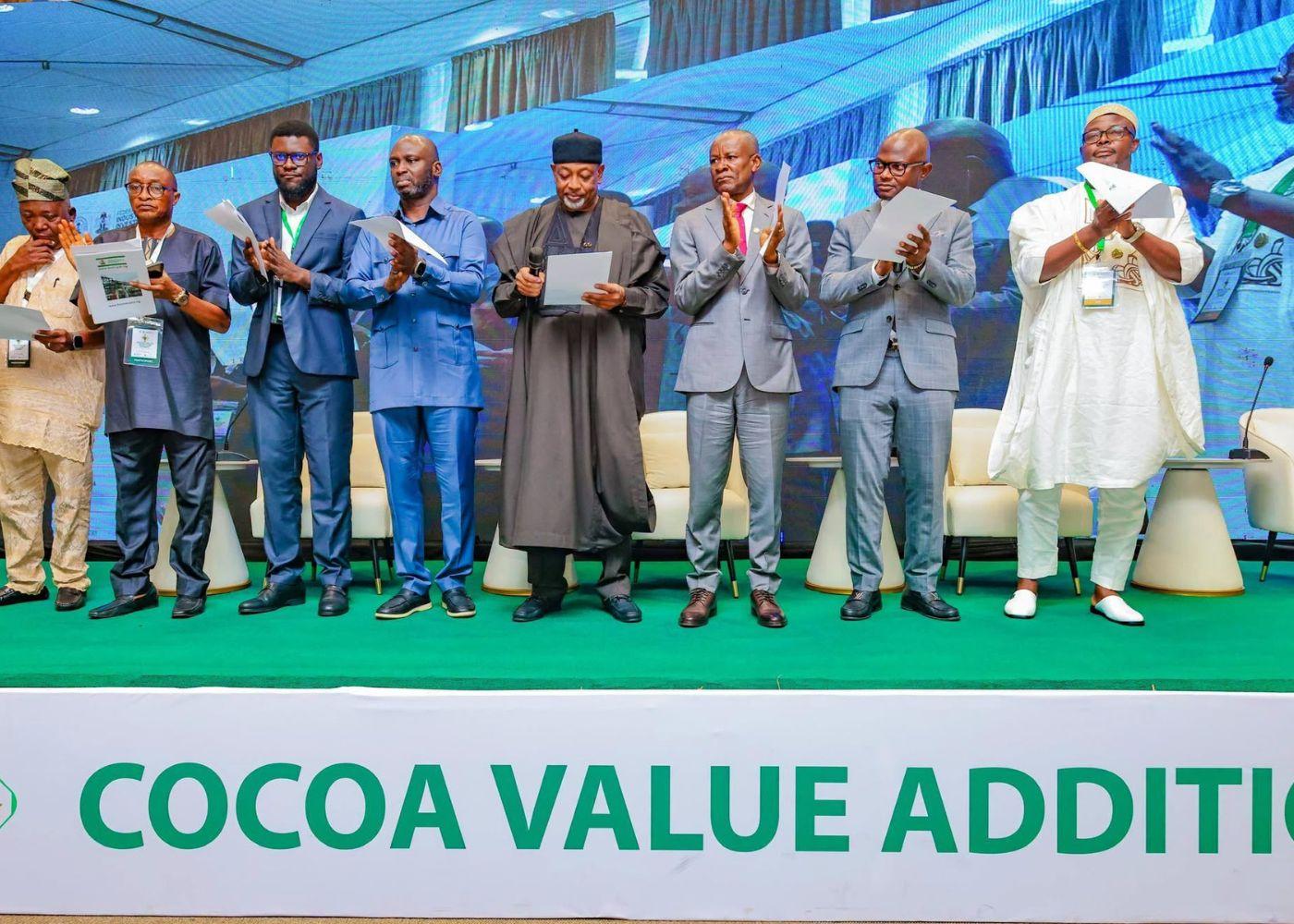
Four major African cocoa-producing nations have adopted a historic cooperative trade agreement to unify agricultural policy, coordinate market regulations, and boost domestic value addition.
Announcing the breakthrough on Wednesday, 15 July 2026, during the Cocoa Value Addition Summit in Abuja, the Minister of State for Industry, Trade and Investment, Senator John Owan Enoh, revealed that Nigeria, Ghana, Cameroon, and Côte d’Ivoire have signed the landmark Abuja Declaration to formally establish the Cocoa Value Addition Alliance.
The bi-national accord establishes a unified, protective front for nations that collectively cultivate approximately 70 per cent of the global cocoa crop. Under the alliance, member countries will end the era of fragmented bilateral negotiations, opting instead to present a single, coordinated voice to international buyers.
Senator Enoh emphasised that the coalition will push back against historical trade inequalities, particularly addressing compliance with the European Union Deforestation Regulation (EUDR).
“For too long, the countries that grow two-thirds of the world’s cocoa have arrived at the world’s negotiating tables one by one… the divide and discount era ends in Abuja,” Enoh declared, noting that the alliance will ensure the costs of sustainability are shared across the entire global retail chain rather than pushed down onto smallholders.
The cooperative framework is backed by concrete domestic financing plans to encourage local industrial processing.
The Managing Director of the Bank of Industry (BOI), Dr Olusupo Olusi, revealed that the bank is establishing a dedicated funding window to finance state-of-the-art cocoa processing plants, prioritising projects that actively partner with smallholders.
Dr Olusi highlighted the stark disparity in the chocolate value chain, pointing out that while the retail chocolate market is valued at up to $150 billion globally, the farmers who harvest the raw beans receive only a fraction of that value, often as low as six to eight per cent of a chocolate bar’s shelf price.
The alliance will invest heavily in domestic processing infrastructure and traceable tracking systems.
Following wild price fluctuations over the last two years, with global cocoa prices surging near $13,000 per ton in late 2024 before stabilising near $6,000 per ton in July 2026, the alliance aims to help African producers capture higher margins during market reshuffles.
Dr Olusi noted that Nigeria alone earned a windfall of ₦2.7 trillion from cocoa exports in 2024, urging that these revenues must be reinvested into processing plants rather than simple consumption.
Senator Enoh added that the newly adopted national traceability systems will protect farmers by mapping farms by coordinates, turning international compliance guidelines into premium trade rewards.
Source: The Nation News
Image Credit: Senator John Owan Enoh