Precision agriculture is often discussed as the future of farming; yet, for many African farmers, it still feels distant and unaffordable. Femi Adekoya believes it does not have to be that way. Femi Adekoya, a precision agriculture specialist and founder of Integrated Aerial Precision, focuses on helping farmers see what is happening in their fields before damage becomes irreversible.
With his company, he is applying drone technology to make farm data more accessible and actionable. In this interview, he discusses how drone data is changing farm management and what it will take for precision agriculture to scale across Africa.
Could you please introduce yourself?
My name is Femi Adekoya, and I am the founder and managing director of Integrated Aerial Precision, as well as the lead visionary at the Precision Field Academy. My personal journey into agriculture was sparked by a belief I developed as a child growing up in suburban Lagos, the idea that planting a single seed of maize could yield hundreds in return. That early fascination led me to study agriculture, specifically Horticulture, at the university level.
How did you come about the name “the flying farmer”? Is there a story behind that name?
The name grew out of the idea of flying drones and everything associated with aviation in agriculture. Perhaps it’s also the idea of agriculture making me fly, or vice versa. It has been the brand ever since.
When did you first realise that drones could play such a transformative role in farming across Nigeria and the wider continent?
Which specific challenges strengthened your resolve to use a tech-first solution?
My Master’s was in Integrated Pest Management (IPM), and I know from experience that our farmers lose up to 40% of their yield on the field, even before harvest, due to pests, diseases, and weeds. Think of it like human health; the key to battling a disease like cancer is early detection. In crops, if you wait until you see symptoms like yellowing, you’ve already sustained a yield penalty. Drones close the “information gap,” helping farmers collect data to make informed decisions on where to plant, when to spray, and how to manage their investment holistically.
Have you had personal experiences with crop loss that shifted your perspective?
Absolutely. Around 2017 or 2018, I planted maize and brought in friends and family as investors. Everything was doing well until a pest struck, damaging the crops so severely that there was no tangible yield or return on investment. I’ve had similar experiences with tomatoes, Tuta absoluta. These realities, disease, climate change, and market uncertainty, are exactly what keep farmers trapped in poverty.
Can you share a real-world solution where the data you collected altered a farmer’s decision, and what happened next?
We help farmers collect and process data into actionable insights, which are critical since information is a primary factor of production alongside land, labour, and capital. To maximise these resources, farmers need high-resolution data on land slope, optimal irrigation methods, plant population, and disease detection.
We deploy drones to perform inventory analysis and “stand counts” shortly after germination. For example, maize typically germinates within five to seven days of planting, but tracking the exact germination percentage across a vast field is difficult. By mapping fields at a very high resolution, we use computer vision analytics to provide precise population estimations for cassava, maize, or tree crops like oil palm. This data informs early yield estimations and immediate replanting decisions.
Our crop health monitoring via drones identifies localised anomalies such as pest infestations, diseases, or irrigation deficiencies. Across numerous maize and oil palm farms, this elimination of guesswork has directly resulted in increased yields, enhanced operational efficiencies, and a substantial reduction in the use of water and agrochemicals.
How do you measure the tangible impact your organisation has made so far?
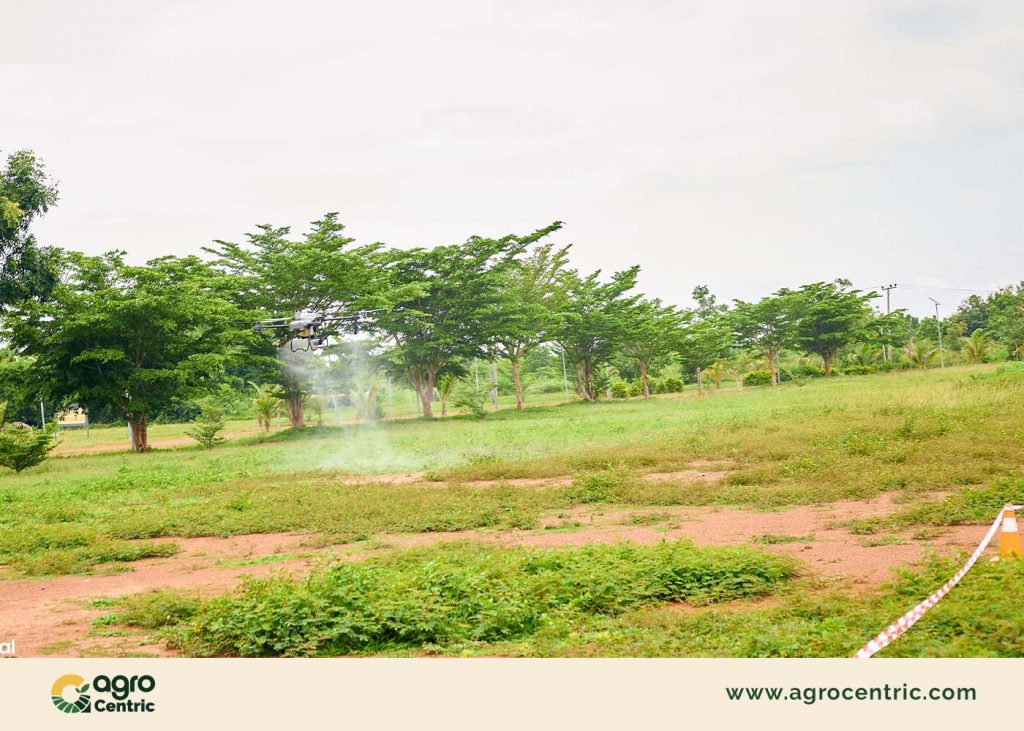
We’ve helped farmers reduce chemical input costs by 30% and water input by 90%. To give you a practical example: a manual knapsack sprayer might take four hours to cover one hectare. With our technology, they can do it in 5 to 10 minutes. We’ve seen farmers scale from 2 hectares to 10, to 50, because they finally have the tools to manage growth efficiently.
We also worked actively to demonstrate the importance of drone technology to the government through the Fourth Industrial Revolution (4IR) Technology Application project. During this project, we demonstrated the practical use of UAVs in a real-world setting, showing that this technology is suitable for our ecosystem. This has led to accolades and recognition from reputable organisations both locally and globally.
Was that the motivation behind Integrated Aerial Precision? What is your core vision?
My passion turned into a purpose to solve these systemic problems. We founded the company in 2020 to leverage technology to help Africa achieve food sufficiency. Our vision is to make precision agriculture mainstream and decentralise this technology. This includes educating smallholder farmers and training the next generation of digitally savvy farmers through our Precision Field Academy.
Have you ever worked in a community that completely resisted or distrusted this technology? How did you manage that friction?
We generally receive highly positive responses because we are solving an undeniable pain point. However, initial misconceptions do occur, often due to a farmer’s previous engagement with other technology service providers whose tools failed to deliver on their promises.
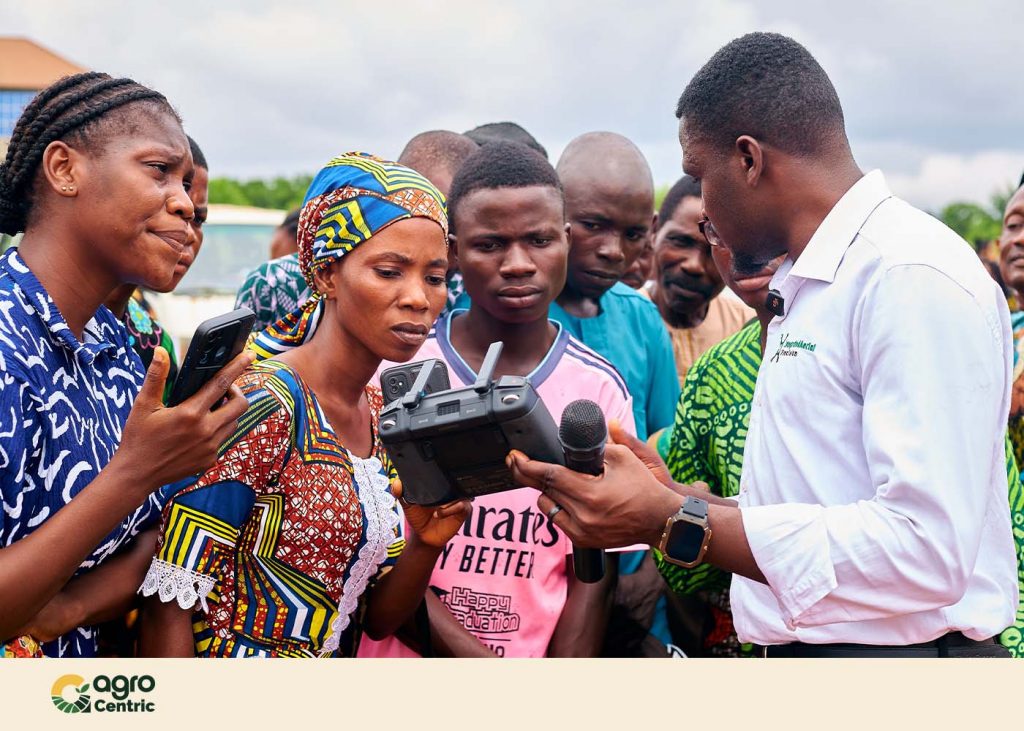
We navigate this hesitation purely through direct field demonstrations. In our line of work, “seeing is believing”. By demonstrating the immediate, tangible value of our technology on their own soil, we successfully convert scepticism into enthusiastic acceptance
Precision agriculture is typically associated with large-scale farming. What is a realistic model to ensure smallholder farmers benefit and are not left behind?
Precision agriculture is a concept applicable to any scale, though its impact is most visible when executed at scale. To deliver the benefits of scale to smallholders who are economically constrained, the government must establish farming clusters and agricultural estates. Smallholders do not need to purchase drone technology outright. Service providers like Integrated Aerial Precision can deploy service-based models to serve them efficiently within these clusters.
The government can support this through innovative financing instruments and targeted subsidies for cooperative groups to bridge the cost gap. In reality, technology and the word “cheap” rarely go together; like the initial rollout of mobile phones, market forces and institutional backing will eventually lower costs. Private service providers are not charities and must balance their books, making the last mile difficult to serve without the active intervention of governments and development organisations to create win-win models for food security.
Based on your work with government initiatives, Fourth Industrial Revolution (4IR) technology application project, what specific policy or regulatory transformations would most effectively accelerate agrotech adoption in Nigeria?
True transformation requires strong political will from the government. Secondly, the state must put its money where its mouth is; genuine agrotech transformation demands robust, solid investment. We must move away from purely political initiatives focused on gathering numbers and taking photos, and pivot toward creating sustainable economic impacts on farmer livelihoods. Whether the policy involves subsidies or import regulations, it will fail if it impacts the farmer negatively.
Instead of handouts, we need decentralised, supportive policies that enable innovators to solve real agricultural problems. Technology allows for scale, and we must stop romanticising being small, as scale is what brings true landscape transformation. Furthermore, we must update our educational curriculum to reflect the current digital age, shifting university education toward problem-solving models.
How has your role as the founder of Integrated Aerial Precision evolved in terms of leadership growth and overcoming challenges since you started?
Leadership and organisational capacity both develop progressively with time. When we began, we lacked the extensive resources we possess today, though we still require more to expand our delivery. I have learned that consistency is a function of time, particularly when you are pioneering an entirely new concept in an uncharted environment.
Navigating uncharted territory demands a deep internal conviction that the model will succeed, a conviction built on my own years of farming and business experience in the agricultural sector. Over time, we have significantly refined how we communicate and reach out, which has accelerated our market traction. This traction, alongside celebrating our small wins, reinforces our resolve to push the mission forward. Building this enterprise requires remaining completely open to feedback from clients, farmers, and stakeholders, and evolving alongside the landscape. To scale this vision mainstream, we cannot rely on one person alone. We are actively training others, replicating our knowledge, and driving widespread awareness, education, and strategic collaborations.
What is the current state of agritech adoption in Nigeria? What are the barriers?
It is still in its nascent stages. The biggest barrier is capital, specifically, “patient” and generous capital. I mentor many youth with brilliant ideas, but the capital to bring them to market isn’t there. We also need inclusive, liberal policies that put innovators at the forefront. Currently, our fragmented farming system makes it complicated; if the government could organise production into coordinated clusters, it would help technology scale.
What practical skills and mindsets must young Africans cultivate to achieve success in the modern agritech sector?
The essential mindset is entering the sector with a singular focus on solving problems. Regardless of how attractive or “sexy” the sector is painted, youth must realise that agriculture is a complex problem terrain. Financial rewards and value are only granted as a consequence of solving those problems. Secondly, young people must refuse to be mere spectators of technological advancement. They must become active players by intentionally committing to capacity building. Cultivating the dual traits of a problem solver and an innovator is the universal requirement to unlock value in this field.
What ultimate legacy do you want to leave behind as “The Flying Farmer”?
I want my work to inspire and raise the next generation of tech-inclined, digitally-savvy agricultural professionals. My ideal legacy is simply raising more “Flying Farmers” who possess the drive, passion, and purpose to make a tangible impact on human livelihoods. Ultimately, I want my life’s light to light up another person’s candle to serve humanity profitably
Is there a recurring question or a common misconception about your journey that you frequently have to clarify?
People often ask about the process, but we are still very much in it. Agriculture and agritech do not offer a linear career path like medicine, where you finish school, get sworn in, and advance through defined ranks to become a consultant. Here, you must map out your own path by identifying a problem to solve. Some problems offer no immediate financial reward, requiring patience, continuous capacity building, and hard work. For those looking to join our work, we run the Precision Field Academy, where young people can sign up for courses, secure mentorship, and join a community of thousands of youth sharing ideas and opportunities.
With artificial intelligence (AI) expanding across healthcare and education, how will AI influence the agricultural landscape, and what should we anticipate?
AI is no longer a future revolution; it is our current reality. Just as the internet completely transformed human connectivity over the last 30 years, AI is doing the same today. My goal is to ensure African youth are creators and enablers of this trend, not passive observers. Anyone who cannot leverage AI as a tool to solve problems will soon become irrelevant. In the near future, AI will completely automate agronomic recommendations. Instead of an agronomist physically visiting a field to diagnose crop symptoms, AI will generate automated diagnostic recommendations using satellite data from the stratosphere, drone imagery, and field photographs. The agronomist of the next decade will not be doing basic field scouting; they will be the computer-literate data cruncher who understands biological complexities and builds the computational models that power these AI systems. We are already growing crops via simulation on computers rather than on physical soil, a methodology I am currently deploying in my own doctoral work to assist plant breeders. Students studying basic agronomy today must move beyond traditional models and transition into the digital, cyberspace application of agriculture. In ten years, what sounds like science fiction today will be completely mainstream
What advice would you give to young innovators who want to make a real impact?
My advice has always been: “The best way to predict the future is to create it”. If you want a better food system, you cannot simply wish for it; you must actively contribute to and innovate for it. See yourself as a creator of the future you desire.
Thank you for the insightful conversation, Femi. Integrated Aerial Precision is on a mission to ensure that all farmers thrive in the digital age. To learn more about their impact on Africa’s AgriTech, you can connect with Femi Adekoya and Integrated Aerial Precision on LinkedIn.
**************** END******************